As we reflect on the importance of honouring and uncovering Aboriginal and Torres Strait Islander health histories—both the positive and the confronting.
McMaster Ward
Stories such as the McMaster Ward in Moree highlight a complex legacy: a segregated ward shaped by inequity yet sustained by the strength and leadership of community caring for their own.
Understanding this history helps explain ongoing mistrust and barriers to care and provides important context for clinicians—particularly those new to our health system—on why health gaps persist.
Learning from the past strengthens our ability to deliver culturally safe, respectful care and work meaningfully toward closing the gap.
Our colleagues in Moree shared a digital copy of Burrul Wallaay (Big Camp) researched by Noeline Briggs-Smith, (Northern Rivers Library and Information Service 2003), which highlights that the McMaster ward was more than a healthcare —it was a vital community hub.
The McMaster Ward at Moree District Hospital was a significant part of local Aboriginal health history, operating from the late 1930s until its closure in April 1965. Established during a time of segregation, the ward provided a dedicated space where Aboriginal patients could receive care—often from Aboriginal nurses and staff themselves.
Operating in challenging conditions, the ward reflected broader issues affecting Aboriginal health, including limited access to clean water, sanitation and timely medical care. Yet, through resilience and dedication, staff and community members worked together to improve outcomes and care for one another.
Today, the legacy of the McMaster Ward lives on through the stories of those who worked and were cared for there. It stands as a powerful reminder of community strength, the importance of culturally safe care, and the contributions of Aboriginal health workers in shaping local health services.
Click: to read Burrul Wallaay (Big Camp)
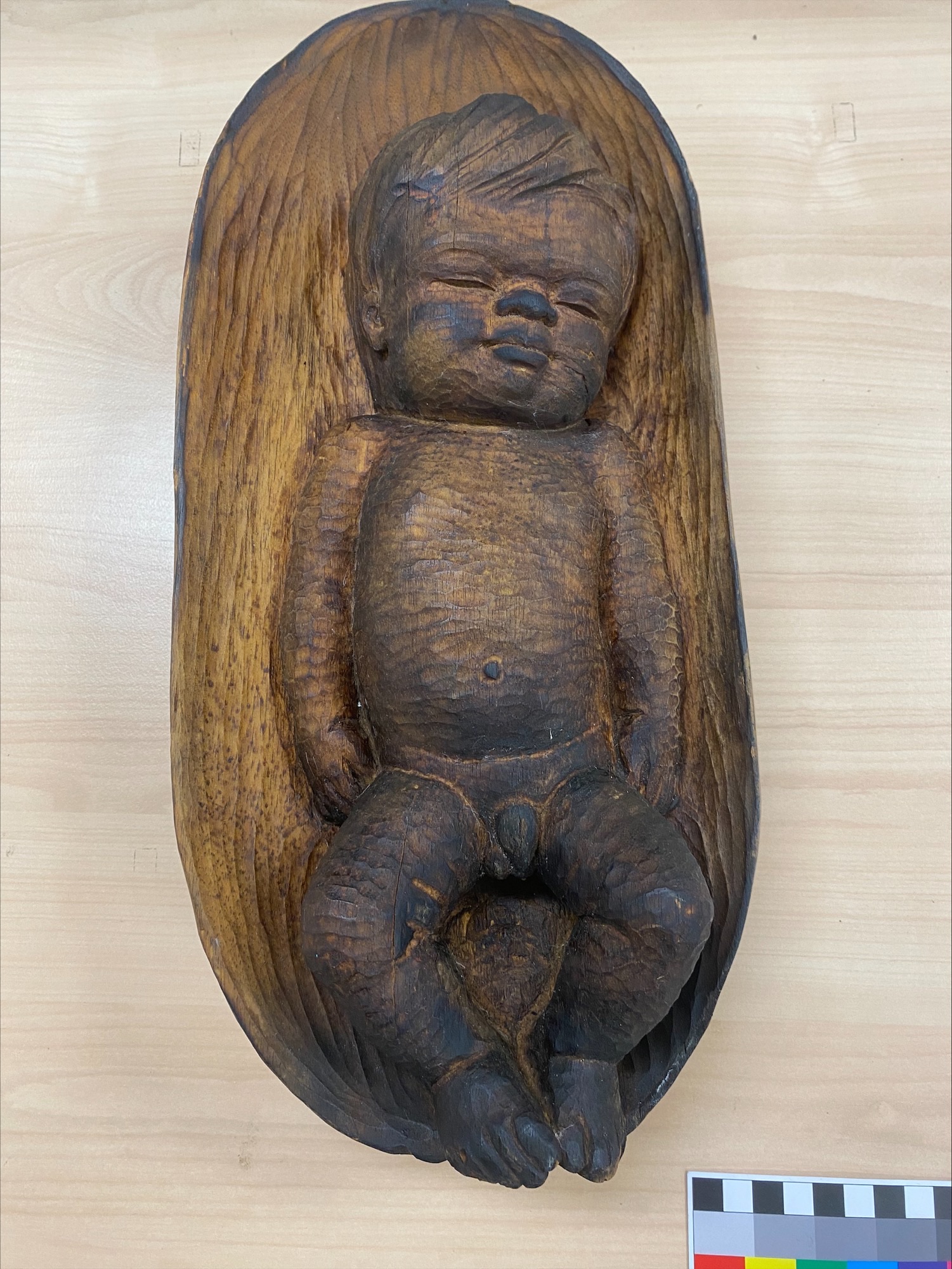
Baby in the Coolamon
This is a sculpture held by HNE Health Libraries in our closed historical collection.
The work depicts a reclining infant figure carved in relief within an oval, coolamon-like form. The figure is rendered with defined facial features, a simplified torso, and limbs integrated into the surrounding wood. The surface shows visible toolwork, tonal variation, and areas of burnishing, indicating hand-carving and finishing processes.
The sculpture is considered culturally and historically significant within the collection; however, there are unresolved aspects of its history and attribution.
Available records indicate that the work was acquired in 1993 by Professor William Walters, then Director of Obstetrics and Gynaecology, and Dr Owen James, then Director of John Hunter Hospital. The sculpture was purchased through a regional gallery identified as Outback Art in Merewether, NSW, and accompanied by certification attributed to Roy Ryan (1993).
The artist is documented as “Ruben Jangala,” with a general note indicating an origin from the Alice Springs region. However, the identity of the artist remains unconfirmed. The use of “Jangala” is significant, as it is a skin name within Walpiri kinship systems, rather than a fixed surname. As such, it does not uniquely identify an individual and complicates direct attribution.
Despite targeted research, no verifiable archival or digital records have been identified for the artist “Ruben Jangala,”
This lack of documentation reflects broader challenges associated with Aboriginal artworks circulating through regional gallery networks during the late 20th century, where recordkeeping practices were often limited or inconsistent.
More Information: HNE Health Libraries Aboriginal Health Specialty Guide.
This guide supports HNE clinicians, students, and staff seeking evidence‑based Aboriginal and Torres Strait Islander health resources for clinical practice, research, and professional learning.
The history of Yallarwah House and NAIDOC Week 2026